telecomvideos.com
Welcome
Login / Register

Most Popular Articles


  • T-Mobile becomes number one US smartphone channel

    Written by Scott Bicheno  Telecoms.com

    T-Mobile

    Disruptive US operator T-Mobile has become the leading sales channel for smartphones in the US, according to new research from Counterpoint.

    T-Mobile overtook Verizon to take the number one smartphone sales spot, having been a distant fourth just two years ago. This change is viewed as indicative of a broader change in the way smartphones are being purchased in the US, with the cost of devices increasingly uncoupled from the service contracts and, if needed, paid for via conventional financing arrangements.

    The US market has undergone significant shifts in the power of the different sales channels with the move to unsubsidized plans,” said Neil Shah of Counterpoint. “The growth of T-Mobile through its different ‘Uncarrier’ moves, the removal of subsidies and enticing subscribers with ‘Simple Choice’ & ‘Jump’ plans, has helped the operator to become the top smartphone sales channel in the USA.

    Samsung and Apple together captured almost two-thirds of the total smartphone shipments share at T-Mobile, with Samsung leading. However, it will be an uphill task for T-Mobile to maintain this lead ahead of Verizon and continue to attract millions of subscribers to its network. The move to unsubsidized and unlocked has also boosted demand in the open channel, which continued to contribute close to 10% of the total shipments in Q1 2016.”

    Conterpoint US smartphones slide 2

    US smartphone sales on the whole declined by 4% year-on-year due to the maturity of the market (most people already have a smartphone) and a lengthening on the upgrade cycle. The latter factor will be a direct result of the shift in buying habits as fewer consumers are being prompted to upgrade their subsidized phones by the renewal of their postpaid contracts.

    “The US market decelerated due to softness in Apple iPhone demand and iPhone SE demand not materializing until Q2 2016,” said Jeff Fieldhack of Counterpoint. “Carriers continued to push subscribers to non-subsidy plans as for the first time more than half of the combined subscriber base of the top four carriers are now on non-subsidized plans. This is a significant shift from the subsidy-driven model just ten to twelve quarters ago. This has changed the basis of competition in US mobile landscape.

    “The focus has shifted to creating more value for the consumer, instead of being device-driven. Unsubsidized device sales have educated consumers that flagship smartphones are costly. This has led to a temporary softness in the device upgrade cycle; the in-carrier upgrade run rate continues to be in 5-6% range per quarter. Handset manufacturers will continue to push hardware and marketing limits to entice subscribers to not defer upgrading.”


    Read more »
  • MPO/MTP Solutions for High Density Applications

    As the bandwidth demands grow rapidly, data centers have to achieve ultra-high density in cabling to accommodate all connections. MPO/MTP technology with multi-fiber connectors offers ideal conditions for high-performance data networks in data centers. This article will introduce information about MPO/MTP solutions, such as MPO/MTP trunk cable, MPO/MTP harness cable and MPO/MTP cassettes.

    MTP/MPO Trunk Cable

    MTP/MPO trunk cables are terminated with the MTP/MPO connectors (as shown in the following figure). Trunk cables are available with 12, 24, 48 and 72 fibers. MTP/MPO trunk cables are designed for data center applications. The plug and play solutions uses micro core cable to maximize bend radius and minimize cable weight and size. Besides, MTP/MPO trunk cables also have the following advantages:

    • Saving installation time–With the special plug and play design, MTP/MPO trunk cables can be incorporated and immediately plugged in. It greatly helps reduce the installation time.
    • Decreasing cable volume–MTP/MPO trunk cables have very small diameters, which decrease the cable volume and improve the air-conditioning conditions in data centers.
    • High quality–MTP/MPO trunk cables are factory pre-terminated, tested and packed along with the test reports. These reports serve as long-term documentation and quality control.

    Trunk-Cable

    MPO/MTP Harness Cable

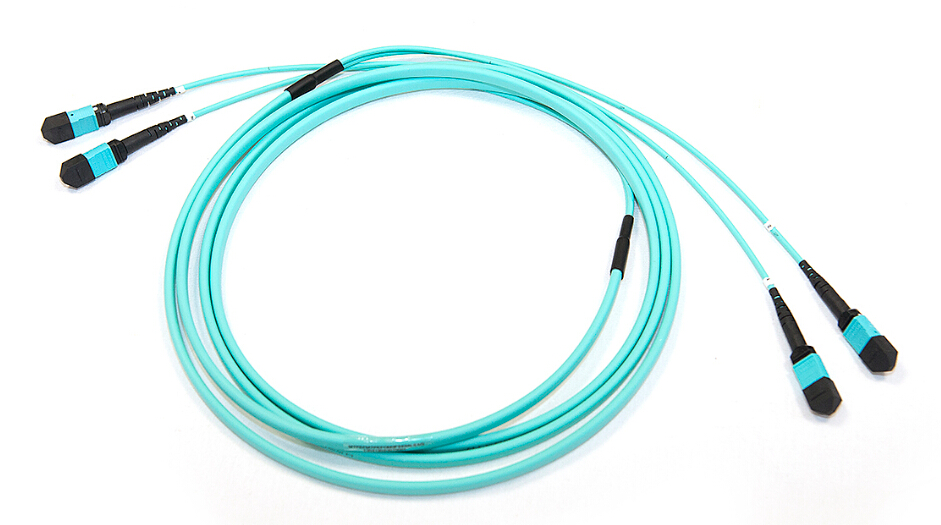
    MPO/MTP harness cable (as shown in the following figure) is also called MPO/MTP breakout cable or MPO/MTP fan-out cable. This cable has a single MTP connector on one end that breaks out into 6 or 12 connectors (LC, SC, ST, etc.). It’s available in 4, 6, 8, or 12 fiber ribbon configurations with lengths about 10, 20, 30 meters and other customized lengths. MPO/MTP harness cable is designed for high density applications with required high performance. It’s good to optimize network performance. Other benefits are shown as below:

    • Saving space–The active equipment and backbone cable is good for saving space.
    • Easy deployment–Factory terminated system saves installation and network reconfiguration time.
    • Reliability–High standard components are used in the manufacturing process to guarantee the product quality.

    Harness-Cable

    MPO/MTP Cassette

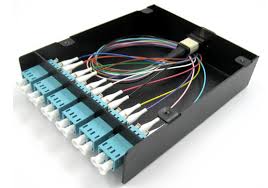
    MPO/MTP cassette modules provide secure transition between MPO/MTP and LC or SC discrete connectors. They are used to interconnect MPO/MTP backbones with LC or SC patching. MPO/MTP Cassettes are designed to reduce installation time and cost for an optical network infrastructure in the premises environment. The modular system allows for rapid deployment of high density data center infrastructure

    Cassette

    as well as improved troubleshooting and reconfiguration during moves, addons, and changes. Aside from that, it has other advantages:

    • MPO/MTP interface–MPO/MTP components feature superior optical and mechanical properties.
    • Optimized performance–Low insertion losses and power penalties in tight power budget, high-speed network environments.
    • High density–12 or 24 fiber cassettes can be mounted in 1U scaling up to 72 or in 3U scaling up to 336 discrete LC connectors.

    The above shows that the MPO/MTP system is a good solution for data center requirements. This high density, scalable system is designed to enable thousands of connections.

    Read more »
  • 40G QSFP+ Transceiver Modules and DAC/AOC Cables Installation Guide

    To install and remove the transceiver optics in a right way is very necessary to ensure the network to work stably and efficiently. Today, we are going to introduce an installation guide of QSFP transceivers and DAC/AOC cables in 40G network.

    40GbE QSFP+ Transceivers Overview

    40 Gigabit Ethernet (40GbE) aggregation switches are becoming more common in today's data centers. At the heart of the 40GbE network layer is a pair of transceivers connected by a cable. The transceivers are plugged into either network servers or a variety of components including interface cards and switches and connected via the cables such as OM3 and OM4 for multimode application. Additionally DAC (Direct Attach Copper) cables or AOCs (Active Optical Cables) are used for short interconnection as a more cost-effective alternative solution. QSFP+ (Quad Small Form-factor Pluggable Plus) is the most common 40GbE interface type, and also as a high-density 10GbE interface via QSFP+ breakout cables. QSFP+ interfaces a network device (switch, router, media converter or similar device) to a fiber optic or copper cable, supporting data rates from 4x10 Gbps and supports Ethernet, Fibre Channel, InfiniBand and SONET/SDH standards with different data rate options. Compared to CFP (C form-factor pluggable) transceiver modules, QSFP transceiver modules are more compact and more suitable for port-density application. The two basic interface specifications of QSFP+ modules respectively for multimode and single-mode applications are 40GBASE-SR4 and 40GBASE-LR4.

    40GBASE-SR4 QSFP+ Module

    The 40GBASE-SR4 QSFP+ module, conforming to the 802.3ba D3.2 (40GBASE-SR4) standard, provides a 40Gbps optical connection using MPO/MTP® optical connectors. This optical module integrates four data lanes in each direction with 40Gbps aggregate bandwidth and each lane can operate at 10.3125 Gbps. It is used in data centers to interconnect two Ethernet switches with 8 fiber parallel multimode fiber OM3/OM4 cables (transmission distance can be up to 100 meters using OM3 fiber or up to 150 meters using OM4 fiber).


    40GBASE-LR4 QSFP+ Module

    The 40GBBASE-LR4 QSFP+ module, conforming to the 802.3ba (40GBASE-LR4) standard, provides a 40Gbps optical connection using LC optical connectors. This optical module integrates four data lanes in each direction with 40Gbps aggregate bandwidth and each lane can operate at 10.3125 Gbps. It is most commonly deployed between data center or IXP sites with single-mode fiber up to 10 km.

     In addition, to satisfy a number of different objectives including support for MMF and SMF compatibility, there are other types of QSFP+ modules offered by different vendors.

    How to Install/Remove QSFP+ Transceivers and DAC/AOC Cables
     
    Preparations

    To protect a QSFP+ module or cable from ESD (electro-static discharge) damage, before installing or removing a QSFP+ module or cable, be remembered that always wear an ESD wrist strap and make sure that it makes good skin contact and is securely grounded (If you are using ESD gloves, wear the wrist strap outside the ESD glove).

    To Install or Remove a QSFP+ Transceiver Module

    There are two types of clasp designed for a QSFP+ transceiver module—plastic clasp or a metallic clasp. Here uses the metallic clasp type as an example.

    To Install a QSFP+ Transceiver Module

    Step 1. Remove the QSFP+ module from its antistatic container and remove the dust covers from the module optical connector.
    Step 2. Remove any rubber dust covers from the port where you are installing the QSFP+ module.
    Step 3. Pivot the clasp of the module up. (Skip this step if the clasp is plastic.)
    Step 4. Align the module with the port in the chassis, as shown in Figure 1.

    Figure 1. Aligning the module with the port
    Figure 1. Aligning the module with the port

    Step 5. Holding the module, gently push in the module until it is firmly seated in the port.(see Figure 2.)

    Figure 2. Install the QSFP+ module to port
    Figure 2. Install the QSFP+ module to port

    Step 6. Immediately attach the patch cord with MPO connector or duplex LC connector to the QSFP+ transceiver module.(see Figure 3.)

    Figure 3. Install the patch cord to the module
    Figure 3. Install the patch cord to the module

    Note: Install the dust plug for the transceiver module if you are not to install an optical fiber into it.

    To Remove a QSFP+ Transceiver Module

    Step 1. Remove the optical fiber if any.
    Step 2. Pivot the clasp of the module down to the horizontal position. (Skip this step if the clasp is plastic.)
    Step 3. Holding the module, gently pull the module out of the port. (Figure 4)
    Step 4. Place the QSFP+ transceiver into an antistatic bag.

    Figure 4. Remove the QSFP+ module
    Figure 4. Remove the QSFP+ module

    To Install or Remove a 40G QSFP+ Cable

    The installation and removal procedures are the same for QSFP+ DAC cables and QSFP+ AOC cables. Here uses a QSFP+ DAC cable as an example:

    To Install a QSFP+ DAC Cable

    Step 1. Align the QSFP+ transceiver module (with the clasp on top) at one end of the cable with the port in the chassis, as shown in Figure 5.
    Step 2. Horizontally and gently push in the module to fully seat it in the port.

    Figure 5. Installing a QSFP+ DAC cable
    Figure 5. Installing a QSFP+ DAC cable

    To remove a QSFP+ DAC Cable

    Step 1. Gently press and release the QSFP+ transceiver module.(see Figure 6.)
    Step 2. Holding the cable, gently pull the clasp on the cable to pull out the transceiver module.

    Figure 6. Removing a QSFP+ DAC cable
    Figure 6. Removing a QSFP+ DAC cable

    To Install or Remove a 40G QSFP+ to 4x10G SFP+ Cable

    40G QSFP+ to 4x10G SFP+ cable combines one 40G QSFP+ module on one end and four 10G SFP+ module on the other end. The installation and removal procedures of 40G QSFP+ connector are introdueced above. Here only introduced the installation and removal of 10G SFP+ module:

    To Install an SFP+ Transceiver Module

    Step 1. Align the module with the SFP+ port, with the golden plating facing the spring tab (see Figure 7.) in the SFP+ port. If the chassis has two rows of ports, the spring tab in a port is on the bottom in the upper row and on the top in the lower row.
    Step 2. Slightly press the module against the spring tab so you can push the module straight into the port.

    Figure 7. Installing an SFP+ transceiver module
    Figure 7. Installing an SFP+ transceiver module

    To Remove an SFP+ Transceiver Module

    Step 1. Press the module with your thumb, as shown by callout 1 in Figure 8.
    Step 2. Gently pull the clasp on the cable to pull out the transceiver module, as shown by callout 2 in Figure 8.

    Figure 8. Removing an SFP+ transceiver module
    Figure 8. Removing an SFP+ transceiver module

    Verifying the installation

    Execute the display transceiver interface command on the device to verify that the transceiver module or DAC/AOC cable is installed correctly. If the transceiver module and DAC/AOC cable information is displayed correctly, the installation is correct. If an error message is displayed, the installation is incorrect or the transceiver optics is not compatible.

    transceiver interface command

    Conclusion

    As 40 GbE are widely deployed, 40G transceiver optics are ubiquitous. A good practice and correct installation are very important for 40G network system, not only to protect the 40G transceiver optics and device from damage, but also to ensure a stable performance for system. In addition, by executing the display transceiver interface command, we can verify whether the installation is correct. Of course, the premise is that the transceiver optics you use is fully compatible with your device. COMPUFOX offers a comprehensive line of high-compatible 40G transceiver optics, such as 40GBASE-SR4 QSFP+, 40GBASE-LR4 QSFP+ and 40G DACs and AOCs with competitive prices. See Links below:


    Read more »
  • Huawei Completes 5G Key Technology Tests in the Field Trial Sponsored by IMT-2020 5G Promotion Group

    [Shenzhen, China, May 27, 2016] Huawei completed the first phase of key 5G technology tests as a part of a series field trials defined by the IMT-2020 5G Promotion Group. In April 2016, the outdoor macro-cell tests, conducted in Chendu, China, consist of a number of the foundational key enabling technologies and an integrated 5G air-interface. The test results successfully demonstrated that the new 5G air interface technology can effectively improve spectrum efficiency and to meet diverse service requirements for 5G defined by ITU-R.


    Huawei completes 5G key technology tests in 5G field trial

    Strong Promotion for Global Partnership on 5G Technology Innovation and a Global 5G Standard

    Launched by China Academy of Information and Communication Technology (CAICT), the IMT-2020 5G Promotion Group aims to foster a joint effort to promote 5G technology evaluation and field test among the global mobile industry and ecosystem to ensure the successful commercial deployment by 2020. One of the key objectives for IMT-2020 5G Promotion Group is to realize the 5G vision for the enhanced mobile broadband service as well as to create the new capabilities for 5G to enable the IoT and vertical services, this represents the unprecedented technical challenges such as to realize 10Gbps or peak rate 20Gbps user data rate, 100 billion connections, and 1 ms of end-to-end network latency for the 5G air interface.

    Early this year, IMT-2020 5G Promotion Group announced a three phase 5G networks trial plan, spanning from 2016 to 2018, with a first phase test from September 2015 to September 2016. The first phase test is focused on key radio technologies and performance test.

    As one of the core members in the IMT-2020 5G Promotion Group, Huawei actively contributed IMT-2020 5G Promotion Group and 5G technology test. In addition, Huawei established an extensive collaboration with CAICT, China Mobile, China Unicom, and China Telecom in the Chinese operator community to explore the innovative air-interface technologies to achieve best spectral efficiency and massive links capabilities. Huawei’s effort is focused on New Radio (NR) technology, which includes the optimized new air-interface, full-duplex and massive MIMO technologies, these are the enabling technologies to achieve the superior end-user experience for the emerging mobile broadband service such as 4K, 8K and virtual reality and augmented reality.

    Best-in-Class Test Results Using 5G New Air Interface

    The 5G air interface technology has been implemented through three novel foundational technologies, i.e., filtered Orthogonal Frequency Division Multiplexing (F-OFDM), Sparse Code Multiple Access (SCMA) and Polar code to meet 5G requirements and performance targets.

    F-OFDM technology is the basis for creating ultra-flexible air-interface to adaptively fit all the 5G use-case scenarios defined by ITU-R with a single radio technology platform. It allows multiple concurrent radio numerologies and frame structure to deliver very diverse services; F-OFDM can ensure the future-proof for the 5G system to meet emerging innovative services requirements. The test results showed that F-OFDM can increase system throughput by 10% using those free guard bands in LTE system. In addition, F-OFDM supports asynchronous transmission from different users. Test results showed that it will provide 100% higher system throughput compared with that in LTE system in the presence of mixed service on the same carrier frequency with mixed radio numerologies. .

    SCMA is to support massive connections and obtain higher system throughput simultaneously via the joint optimization on sparse SCMA codebook design and multi-dimensional modulation. It can further consider optimization on power allocation among different SCMA layers especially in downlink to improve total system throughput. The test results showed that SCMA is to increase the uplink connection number by 300% and at the same time increased the downlink system throughput up to 80%.

    For Polar code, it allocates information to the highly reliable data locations in the code structure to transmit useful information of user and at the same time it supports channel coding of any code rate with an appropriate code construction to fit any future service requirements. The test results showed that Polar code provided coding gain from 0.5dB to 2.0dB compared with Turbo code used in LTE system.

    System Integration of Innovative 5G Air Interface Technologies

    The flexible system integration of several innovative 5G air-interface technologies, namely, F-OFDM, SCMA and massive MIMO has been verified in the first phase of key 5G technology tests. In the test, multi-user MIMO (MU-MIMO) supported up to 24 users and up to 24 parallel layers transmission on the same time-frequency resources. The test results showed that MU-MIMO can achieve 3.6Gbps cell average throughput using 100MHz system bandwidth, it is almost 10 times of that in LTE baseline system.

    The trial has validated the optimal integration of the above new radio technologies and the capability of flexible 5G air-interface technologies, the trial is also served as a technical re-risk to support the on-going 3GPP standardization work.

    Full Duplex Implemented in the First Phase of 5G Test

    Full Duplex mode has also been tested in the first phase of 5G test. In the initial test stage on Full Duplex, it allows simultaneous transmitting and receiving of data at the base station with three level cascaded technologies, namely, passive analog cancellation, active analog cancellation, and digital cancellation. The test results showed that the Full Duplex can provide self-interference cancellation capability more than 113dB in real world environment and result in a total 90% system throughput gain over the conventional half duplex mode used today.

    Huawei has successfully completed the first phase test of 5G technologies in China. "The trial of 5G technologies in China will be a great contribution to 5G applications in the future.” Dr. Wen Tong, Huawei 5G Chief Scientist emphasized that, "As a member of the IMT-2020 5G Promotion Group, Huawei is pleased to work with CAICT, China Mobile, China Unicom, and China Telecom, and took the initiative to be the first to complete 5G key technologies tests and corresponding system integration test based on our proposed 5G new air interface."

    He also announced the plan of the second phase of 5G test which will focus mainly on the wide coverage, high hotspot capacity, and massive connections with high reliability, low latency with reduced power consumption.

    Read more »
  • LSZH Fiber Optic Cables Tutorial

    Since the 1970s, the wire and cable industry has been using low-smoke, low-halogen materials in a number of applications. The objective was to create a wire and cable jacketing that was not only flame retardant but also did not generate dense, obscuring smoke and toxic or corrosive gases. Several notable fires over the years (such as the King's Cross Fire that killed 32 people in London's underground subway in 1987) increased the awareness of the role that wire and cable jacketing plays in a fire and contributed to a greater adoption of Low-Smoke Zero-Halogen (LSZH) cables.

    With an increase in the amount of cable found in residential, commercial and industrial applications in recent years, there is a greater fuel load in the event of a fire. Wire and cable manufacturers responded by developing materials that had a high resistance to fire while maintaining performance. Low-smoke, zero-halogen compounds proved to be a key materials group that delivered enhanced fire protection performance. Today, LSZH cables are being used in applications beyond the traditional transit, shipboard, military and other confined-space applications. This tutorial is provided to help you learn more about the LSZH fiber optic cables.

    What is LSZH Fiber Optic Cable?

    LSZH Fiber Optic Cable is a kind of fiber optic cable of which the jacket and insulation material are made of special LSZH materials. When these cables come in contact with a flame very little smoke is produced making this product ideal for applications where many people are confined in a certain place (office buildings, train stations, airports, etc.). While a fire may be very harmful in a building, the smoke can cause more damage to people trying to locate exits and inhalation of smoke or gases.


    Fiber optic cable insulation and jacket made from LSZH materials are free of halogenated materials like Fluorine (F), Chlorine (Cl), Bromine (Br), Iodine (I) and Astatine (At), which are reported to be capable of being transformed into toxic and corrosive matter during combustion or decompositions in landfills.

    The most prominent characteristic of LSZH fiber optic cable is safety. LSZH fiber optic cables are used in public spaces like train and subway stations, airports, hospitals, boats and commercial buildings, where toxic fumes would present a danger in the event of a fire. Similarly, low-smoke property is also helpful. More people in fires die from smoke inhalation than any other cause. Using LSZH fiber optic cables which release low smoke and zero halogenated materials in these places would be really important to the safty of people.

    Applications of LSZH Fiber Optic Cables

    There is no doubt that the amount of fiber optic cables installed in buildings has been increasing as data communication proliferated. Central office telecommunication facilities were some of the first places that LSZH cables became common due to the large relative fuel load represented by wire and cable.

    Public Spaces like train stations, hospitals, school, high buidings and commercial centers where the pretection of people and equipment from toxic and corrosive gases is critical should apply LSZH fiber optic cable for the safty of people.

    Data Centers contain large amounts of cables, and are usually enclosed spaces with cooling systems that can potentially disperse combustion byproducts through a large area. In industrial facilities, the relative fuel load of cables will not be at the same level. Other materials burning may also contribute greater amounts of dangerous gases that outweigh the effect of the cables. There have been notable fires where cables burning contributed to corrosion (the Hinsdale Central Office fire is a famous example), but in some instances, better fire response techniques could have prevented this damage.

    Nuclear Industry is another area where LSZH cables have been and will be used in the future. Major cable manufacturers have been producing LSZH cables for nuclear facilities since the early 1990s. The expected construction of new nuclear plants in the U.S. in coming years will almost certainly involve some LSZH cable.

    One of the most important things to understand about LSZH fiber optic cable is that no two products are the same and that there are many factors that will define the suitability of the final product to its application. In fact, research done by a major pulling lubricant supplier tested 27 LSZH compounds and found a huge variation in physical properties. So even using material that meets the base requirements of one of the many specifications available may not result in the best material for the application. Understanding the goals, results and limits of these tests are key to finding the right product. In any case, the trend to consider environmental concerns with a greater weight relative to performance has increased and it can be generally stated that there is an enlarging market for fiber optic cables that can be demonstrated to be environmentally friendly.

    Conclusion

    When selecting or designing a fiber optic cable for any application, the operating enviroments where the fiber optic cable will be used, whether extreme or not, must be considered along with availability, performance, and price, among other things. And when the safety of humans and the enviroment is a consideration, along with high-performance and capability, then LSZH fiber optic cables are what you must specify.

    Warm Tips: When choosing LSZH fiber optic cables, factors such as the environment and price should be considered. An environmental factor such as the temperature of the installation could reduce the flexibility of the cable. Will the application be in an open area or confined? Will other flammable material be present? LSZH fiber optic cables also tend to be higher in cost. 

    Read more »
RSS